




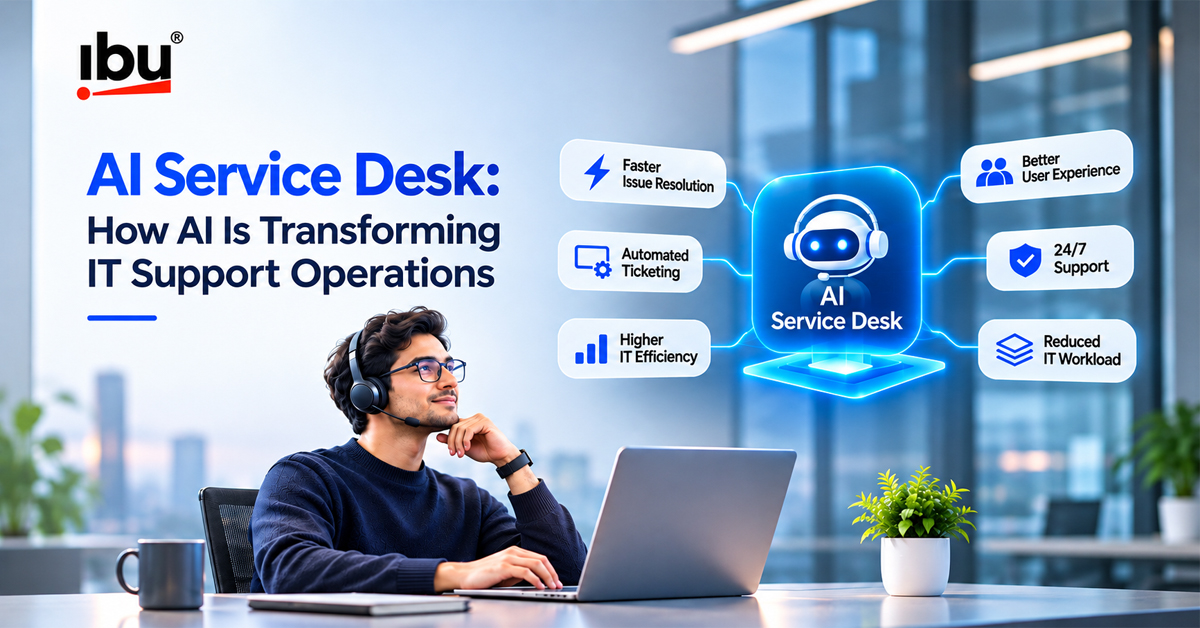
AI Service Desk
AI Service Desk: How AI Is Transforming IT Support Operations
An AI service desk uses artificial intelligence, machine learning and large language models (LLMs) to automate and improve IT support activities. It can help organisations manage support tickets, answer employee queries, retrieve information from knowledge bases, recommend troubleshooting steps and route incidents to the right teams.
Traditional IT service desks often depend on manual ticket handling and repetitive support processes. An AI-powered IT service desk introduces intelligent automation, helping IT teams manage routine requests while focusing their attention on complex technical issues.
As enterprises adopt AI across their operations, AI service desks are becoming an important consideration for improving IT service management and employee support.
What Is an AI Service Desk?
An AI service desk is an IT support environment that uses AI technologies to understand requests, provide relevant responses and assist with service management workflows.
Unlike traditional service desks, which rely heavily on predefined rules and manual intervention, AI-powered service desks can interpret natural language, identify user intent and retrieve relevant information.
For example, when an employee reports that they cannot access a business application, an AI service desk can understand the request, suggest relevant troubleshooting steps, retrieve instructions from an internal knowledge base or create and categorise a support ticket.
Depending on system permissions and integrations, it may also automate approved actions or escalate the request to a human support professional.
How Does an AI Service Desk Work?
An AI service desk combines different technologies to support IT operations.
- Large Language Models (LLMs): Understand employee queries and generate contextually relevant responses.
- Natural Language Processing (NLP): Interpret user requests and identify their intent.
- Machine Learning: Help classify requests and identify patterns in support data.
- Knowledge Base Integration: Retrieve relevant information from internal documentation and support resources.
- Workflow Automation: Trigger approved actions, update tickets and route requests between systems.
Together, these capabilities help transform a basic support request into a more structured and efficient workflow.
What Are the Key AI Service Desk Use Cases?
AI service desk use cases extend beyond answering employee questions. They can support several stages of the IT support process.
- Automated IT Ticket Management
AI can analyse incoming support requests, identify their categories and assign priority levels based on predefined business rules and context.
For example, a request about an application outage can be classified differently from a routine software access request. The system can then route each ticket to the appropriate support team.
- Password Reset and Account Support
Routine requests involving password resets, account access and software permissions can consume considerable IT support time.
An AI-powered service desk can guide employees through approved self-service workflows. Where integrations and security controls permit, it can initiate authorised actions or direct requests to the appropriate team.
- Intelligent Incident Management
AI can analyse ticket descriptions, historical incident information and monitoring alerts to help identify recurring issues.
It can assist support teams by highlighting related incidents, suggesting possible causes and recommending troubleshooting steps. Critical issues can be escalated for human investigation.
- Employee Self-Service and Virtual IT Assistance
Employees can interact with an AI assistant using everyday language instead of searching through lengthy support documentation.
For example, an employee asking how to connect to a company VPN could receive relevant instructions retrieved from the organisation’s approved knowledge base.
- Knowledge Base Search and Information Retrieval
AI can help employees and IT professionals find information across internal documents, troubleshooting guides and support resources.
Using retrieval-augmented generation (RAG), an LLM can retrieve relevant information from approved company knowledge sources before generating an answer. This helps ground responses in organisational information rather than relying only on the model’s general training.
What Are Some Examples of AI Service Desk Applications?
Consider these illustrative enterprise scenarios:
Example 1: Employee software access request
An employee requests access to a business application. The AI service desk identifies the request, checks the relevant workflow and directs it through the required approval process.
Example 2: Repeated application incidents
Several employees report similar application problems. AI can help identify common patterns, group related tickets and bring the issue to the attention of the IT support team.
Example 3: Internal IT troubleshooting
An employee reports a connectivity issue. The AI assistant retrieves relevant troubleshooting instructions from the internal knowledge base and guides the employee through the approved steps.
These examples demonstrate how AI can support existing IT service desk processes without removing the need for human oversight.
What Are the Benefits of an AI-Powered IT Service Desk?
Organisations can gain several operational benefits by introducing AI into IT support workflows.
- Faster request handling: Automate parts of repetitive ticket processing and routine support activities.
- Reduced manual workload: Help IT professionals spend less time on repetitive requests.
- Improved employee experience: Provide easier access to support information and self-service assistance.
- Consistent support processes: Apply standard workflows for ticket classification and routing.
- Better knowledge access: Make internal support documentation easier to search and use.
- More focused IT teams: Allow specialists to concentrate on complex incidents, infrastructure and improvement initiatives.
Actual results depend on implementation quality, data availability, workflow design and the level of automation introduced.
What Challenges Should Businesses Consider?
Implementing an AI service desk requires more than selecting an AI tool. Organisations should consider data security, access permissions, system integration and response accuracy.
AI-generated recommendations should be validated, particularly when requests involve sensitive information or critical business systems. Clear escalation procedures are also necessary when AI cannot confidently resolve a request.
Human oversight, appropriate access controls and continuous performance monitoring should remain part of the service desk strategy.
How Can Businesses Implement an AI Service Desk?
A structured implementation approach can help organisations introduce AI without disrupting existing IT support operations.
- Identify automation opportunities: Start with repetitive support requests and common employee queries.
- Assess existing systems: Review ticketing platforms, knowledge bases and IT workflows.
- Select suitable AI technologies: Evaluate LLMs, knowledge retrieval capabilities and workflow automation tools.
- Integrate with IT systems: Connect the AI solution with approved service desk platforms and enterprise applications.
- Establish governance: Define permissions, escalation rules, security controls and human review requirements.
- Monitor and improve: Evaluate response quality, workflow performance and employee feedback.
Starting with clearly defined use cases allows businesses to assess the value of AI before expanding automation across additional IT operations.
How Can IBU Support Enterprise AI Initiatives?
IBU helps organisations explore technology consulting, digital transformation and Generative AI opportunities aligned with their business requirements.
An AI service desk initiative can involve evaluating existing IT workflows, identifying suitable automation opportunities, integrating enterprise knowledge sources and establishing the right technology architecture.
The objective is to make AI useful within everyday business operations while maintaining security, governance and human oversight. Looking to explore AI-powered IT support for your organisation? Connect with IBU to discuss your enterprise AI and technology consulting requirements.
Frequently Asked Questions About AI Service Desks
What is an AI service desk?
An AI service desk uses artificial intelligence to assist with IT support activities such as ticket management, employee queries, knowledge retrieval and workflow automation.
What are the most common AI service desk use cases?
Common use cases include automated ticket classification, password reset assistance, incident analysis, employee self-service and intelligent knowledge base search.
What is an example of an AI-powered service desk?
An employee reporting a software access issue can receive automated troubleshooting guidance, while the AI system categorises the request and routes it through the appropriate support workflow.
Can an AI service desk integrate with ServiceNow?
AI capabilities can integrate with ServiceNow-based service management workflows, depending on the available products, APIs, configuration and permissions.
Does an AI service desk replace IT support teams?
No. AI can assist with repetitive tasks and routine requests, but human professionals remain important for complex incidents, security-sensitive decisions and situations requiring technical judgement.