



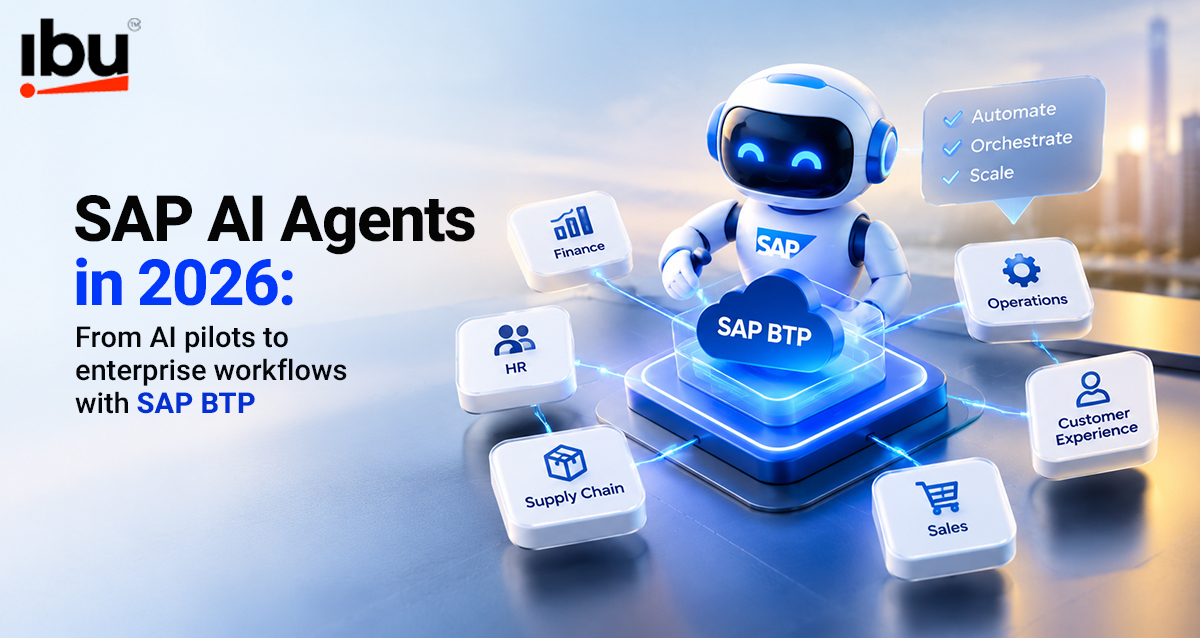
SAP AI Agents in 2026
SAP AI Agents in 2026: From AI Pilots to Enterprise Workflows with SAP BTP
Enterprise AI is entering a new phase. Businesses are moving beyond experimenting with chatbots and generative AI tools toward systems that can support and execute business workflows.
However, implementing AI in a controlled environment is very different from integrating it into everyday enterprise operations. Organizations must connect AI with reliable business data, existing applications, security requirements, and clearly defined processes.
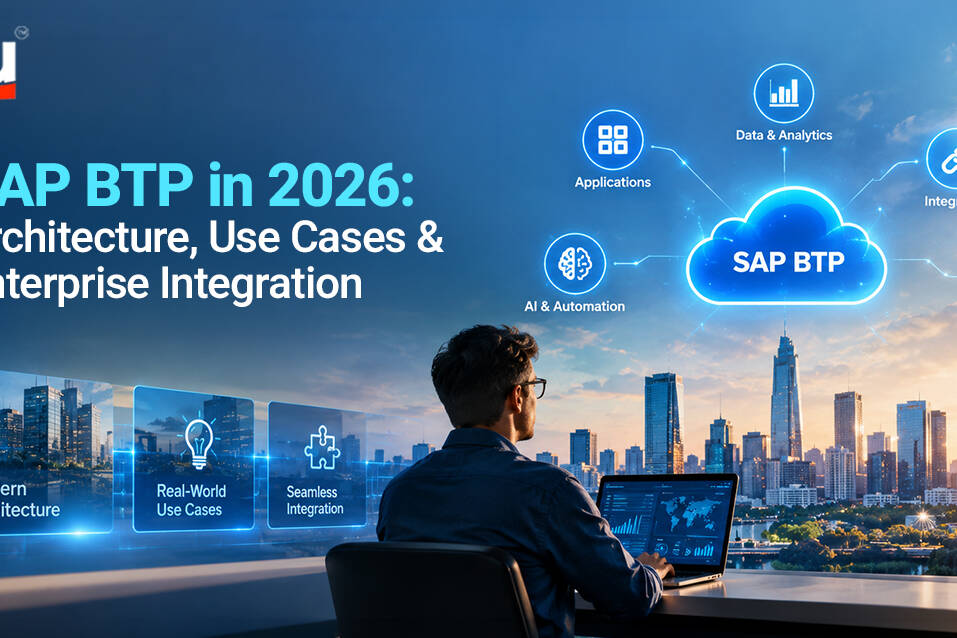
This is where SAP AI agents, SAP Business AI, and SAP Business Technology Platform (BTP) become increasingly relevant.
By combining enterprise context, integration, and AI development capabilities, organizations can move from isolated AI experiments toward connected business processes.
This article explores how these technologies work together, practical enterprise use cases, and what businesses should consider before scaling AI.
What Are SAP AI Agents?
SAP AI agents are AI-powered software components designed to understand business requests, retrieve relevant enterprise information, reason through tasks, and perform actions using connected applications and tools.
Unlike conventional chatbots that primarily generate responses, AI agents can support multi-step processes involving different systems and business rules.
For example, an agent could retrieve purchase order information, identify missing details, recommend the next action, and initiate an approved workflow.
SAP provides development and integration capabilities for building agents on SAP BTP, including connections to SAP and non-SAP environments.
Why Do Enterprise AI Pilots Struggle to Scale?
An AI pilot may perform well with a limited dataset and controlled user interactions. Production environments introduce additional challenges.
Common barriers include fragmented business data, disconnected applications, unclear ownership, inconsistent processes, and insufficient governance.
A successful enterprise AI implementation must therefore address more than model performance.
Organizations need to establish:
- Reliable access to relevant business data.
- Integration with existing applications and workflows.
- Clear permissions and security controls.
- Defined human approval requirements.
- Measurable business outcomes.
Without these foundations, AI risks becoming another disconnected technology rather than an operational capability.
How SAP Business AI and SAP BTP Work Together
SAP Business AI represents SAP’s broader approach to embedding AI capabilities within enterprise applications and business processes.
SAP BTP provides technology services that support the development, integration, and operation of AI-enabled solutions.
Together, these capabilities can help organizations connect AI with business applications, enterprise information, and workflow automation.
Three important components are Joule Studio, SAP AI Core, and the generative AI hub. Their roles are related but distinct.
SAP Joule Studio: Building Business-Aware AI Agents
SAP Joule Studio provides an environment for creating and managing customized AI agents, applications, and workflows.
Developers can define agent instructions, connect business tools, and incorporate relevant process context.
It also supports connecting agents across SAP and non-SAP environments, enabling organizations to develop solutions around existing enterprise workflows.
SAP Generative AI Hub: Accessing AI Models
The SAP generative AI hub provides centralized access to supported generative AI models through SAP AI Core.
It supports model interactions, orchestration, and enterprise controls, allowing developers to incorporate generative AI into business applications without independently managing every model integration.
SAP AI Core: Supporting AI Operations
SAP AI Core provides runtime and lifecycle-management capabilities for AI workloads.
Together, these components create a foundation for developing and operating AI-enabled enterprise solutions.
5 Practical SAP Business AI Use Cases
The following examples illustrate where SAP AI agents and related capabilities can support business operations. They represent potential implementation scenarios rather than guaranteed outcomes.
1. Finance and Invoice Processing
AI can assist with extracting invoice information, identifying discrepancies, and routing exceptions for review.
This can reduce repetitive administrative work while retaining appropriate financial controls.
2. Procurement and Supplier Management
Agents can retrieve supplier information, analyze purchasing records, and assist with procurement workflows.
For example, an agent could identify missing supplier documentation and initiate the relevant follow-up process.
3. Human Resources
AI-enabled workflows can support employee onboarding, policy queries, and administrative requests.
Employees could receive contextual guidance while sensitive decisions remain subject to established HR policies.
4. Supply Chain Operations
Agents can help analyze inventory information, identify potential disruptions, and support operational recommendations.
Connected business data is essential because recommendations must reflect actual inventory, demand, and supply conditions.
5. IT and Application Support
AI can assist with incident classification, knowledge retrieval, troubleshooting guidance, and service-request routing.
These SAP Business AI use cases demonstrate the potential to move beyond isolated AI interactions toward connected operational processes.
SAP also documents customer applications involving procurement agents and AI-supported invoice processing.
Moving From AI Pilots to Production: A Practical Framework
Successful enterprise AI implementation requires a structured approach that aligns technology with business objectives, operational requirements, and governance.
Step 1: Identify a Measurable Business Problem
Select a workflow where improvements can be evaluated through processing time, accuracy, cost, or service quality.
Step 2: Assess Data and Integration Readiness
Identify the information, applications, and APIs the solution requires. Evaluate data quality, system connectivity, and access requirements before implementation.
Step 3: Select the Appropriate AI Approach
Not every process requires an autonomous agent. Conventional automation or AI-assisted workflows may be more appropriate, depending on the complexity of the task and the level of decision-making required.
Step 4: Establish Governance
Define access permissions, human approvals, monitoring requirements, and accountability. Ensure that AI agents operate within approved business rules.
Step 5: Validate Before Scaling
Test the solution against realistic business scenarios, including exceptions, incomplete information, and unexpected outputs. Confirm that the agent behaves reliably before expanding its responsibilities.
Step 6: Monitor Operational Performance
Measure outcomes and continuously review agent behaviour, reliability, and business impact. Use these insights to improve workflows and address performance gaps.
Why Governance Matters for SAP AI Agents
As AI systems gain access to enterprise applications, organizations must control what they can retrieve, recommend, and execute.
Governance should include role-based permissions, data protection, auditability, performance monitoring, and human oversight for consequential actions.
SAP’s Joule Studio documentation emphasizes access management, observability, and lifecycle controls for enterprise agent development.
The objective is not unrestricted autonomy. It is enabling useful automation within clearly defined operational boundaries.
How IBU Supports Enterprise AI Adoption
At IBU Group, we help organizations approach AI adoption through business requirements, technology readiness, and practical implementation.
Our capabilities across Generative AI, technology consulting, application engineering, and digital transformation can support enterprises evaluating AI-enabled workflows and SAP-connected technology environments.
From identifying suitable business processes to assessing integration requirements and developing implementation roadmaps, the focus is on creating solutions that align with existing operations and measurable objectives.
Enterprise AI delivers lasting value when technology, business context, and governance work together.
Frequently Asked Questions
What Is SAP Business AI?
SAP Business AI refers to SAP’s portfolio of AI capabilities designed to support enterprise applications, business processes, and workflows.
What Are SAP AI Agents Used For?
SAP AI agents can support multi-step business activities such as information retrieval, document processing, procurement assistance, workflow coordination, and operational analysis.
What Is the Difference Between SAP Joule and Joule Studio?
Joule provides AI assistance and agent experiences within business workflows. Joule Studio is a development environment for creating and extending customized agents, applications, and workflows.
How Does SAP BTP Support AI Implementation?
SAP BTP provides capabilities for AI development, model access, integration, application development, and automation, helping organizations connect AI with enterprise systems.