



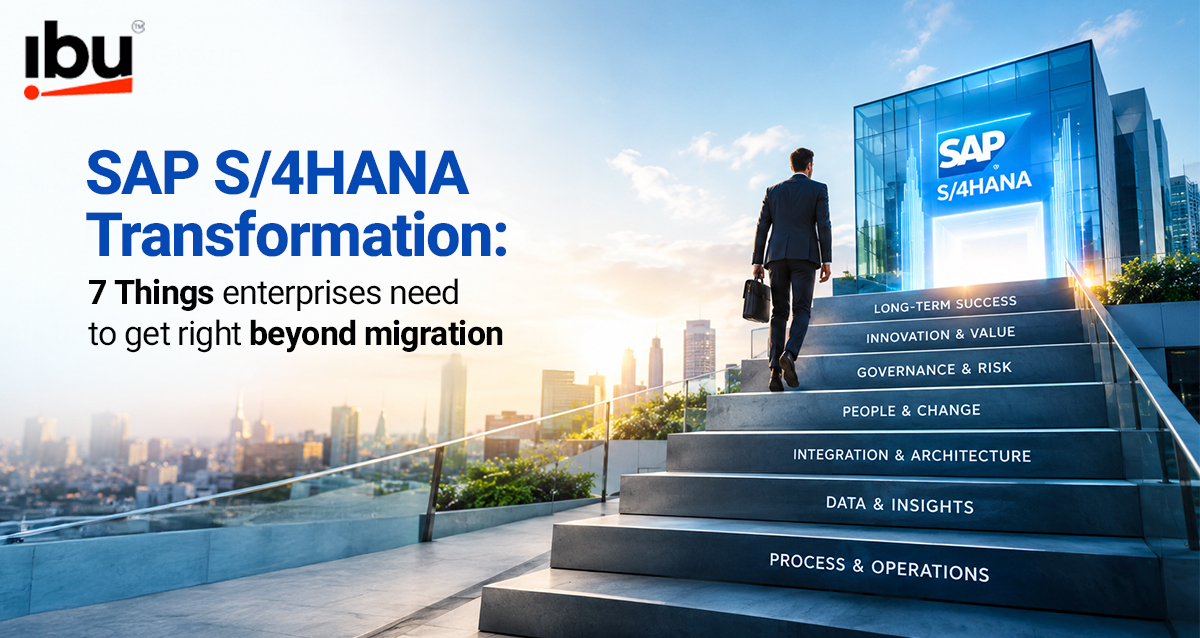
SAP S/4HANA Transformation
SAP S/4HANA Transformation: 7 Things Enterprises Need to Get Right Beyond Migration
Many enterprises treat their SAP S/4HANA transformation as a simple technology migration from SAP ECC. However, replacing an ERP system alone does not guarantee better business performance.
For enterprises, the greater opportunity lies in simplifying processes, improving data quality, modernizing integrations and building a technology environment that can support future growth.
A successful SAP S/4HANA transformation therefore requires more than transferring existing applications and configurations into a new system.
This guide explores seven priorities enterprises should address to move beyond technical migration, from migration strategy and data readiness to clean-core architecture, integration and user adoption, and achieve meaningful business outcomes.
Key Takeaways
-
SAP S/4HANA transformation goes beyond technical migration: it covers processes, data, integrations, architecture and people.
-
The right migration approach (greenfield, brownfield or selective) depends on your customizations, data quality and business goals.
-
A clean-core strategy and early integration planning reduce long-term upgrade and maintenance risk.
-
Mainstream maintenance for SAP ECC ends on 31 December 2027, so planning should start now.
What Is SAP S/4HANA Transformation?
SAP S/4HANA transformation is the process of modernizing an organization’s ERP environment, business processes, data and technology architecture through the adoption of SAP S/4HANA.
Unlike a purely technical migration, transformation considers how the organization operates, how information moves between departments and which existing processes should be redesigned.
For businesses undertaking an SAP ECC to S/4HANA migration, this creates an opportunity to evaluate years of accumulated customizations, fragmented data and operational inefficiencies rather than simply transferring them into a new environment.
1. Define Business Outcomes Before Your S/4HANA Migration
Every SAP S/4HANA transformation should begin with a clear business case.
Organizations need to establish what they expect to improve, whether that involves financial visibility, operational efficiency, process standardization, scalability or technology modernization.
A well-defined SAP S/4HANA migration strategy connects technology decisions to measurable business objectives.
Useful success indicators may include reduced processing time, improved data accuracy, fewer manual interventions and greater visibility across business functions.
Without clear outcomes, a technically successful migration may deliver limited operational improvement.
2. Redesign Business Processes Instead of Replicating Existing Ones
One common transformation challenge is transferring inefficient processes directly into the new ERP environment.
Before SAP S/4HANA implementation, enterprises should review how finance, procurement, inventory, supply chain and other critical processes currently operate.
The objective is to identify unnecessary approval layers, duplicated activities, manual workarounds and outdated customizations.
Standardizing suitable processes can reduce complexity and make future changes easier to manage.
The question should not simply be how to migrate an existing process, but whether that process still makes business sense.
3. Prepare Enterprise Data for SAP S/4HANA Data Migration
Data quality is fundamental to ERP transformation.
Duplicate records, inconsistent master data, outdated information and unclear ownership can create problems during migration and affect downstream reporting.
A structured SAP S/4HANA data migration approach should include data discovery, cleansing, mapping, validation and reconciliation.
Businesses should also establish clear ownership for critical information such as customer records, suppliers, materials and financial data.
Testing should validate not only whether information has transferred successfully, but whether it remains accurate and usable within the new business processes.
4. Choose the Right SAP S/4HANA Migration Approach: Greenfield, Brownfield or Selective
Not every organization should follow the same migration path.
The appropriate approach depends on existing customizations, process complexity, data quality and transformation objectives.
Three commonly considered approaches are:
Greenfield: A new implementation that allows businesses to redesign processes and configurations.
Brownfield: A system conversion that retains suitable elements of the existing ERP environment.
Selective transformation: A targeted approach involving selected processes, organizational structures or data.
An SAP S/4HANA readiness assessment, such as SAP Readiness Check, can help organizations evaluate their existing landscape and determine which approach aligns with their business priorities.
5. Adopt an SAP S/4HANA Clean-Core Architecture
Years of ERP customization can make maintenance and upgrades increasingly complicated.
A clean-core strategy encourages businesses to minimize unnecessary modifications to standard SAP functionality and use supported extension approaches where additional capabilities are required.
For example, organizations can evaluate SAP Business Technology Platform (BTP) for suitable side-by-side application extensions and integration requirements.
A well-planned SAP S/4HANA clean core approach helps enterprises balance business-specific functionality with long-term maintainability.
The objective is not eliminating customization entirely, but ensuring that every extension serves a justified business purpose.
6. Plan SAP S/4HANA Integration Across Enterprise Systems
An ERP system rarely operates independently.
Businesses depend on CRM platforms, HR applications, procurement solutions, analytics tools and external systems that exchange information with their ERP environment.
Successful SAP S/4HANA integration requires identifying these dependencies early.
Organizations should assess existing interfaces, APIs, data flows, security requirements and potential integration failures before implementation.
Integration testing should cover complete business processes rather than validating individual applications in isolation.
This is particularly important when modernization involves a combination of SAP and non-SAP technologies.
7. Prepare People, Change Management and Post-Go-Live Operations
Technology implementation is only one part of enterprise transformation.
Employees need to understand how their responsibilities, workflows and reporting processes will change.
Organizations should develop training programs and a structured change management plan, establish process ownership and involve relevant business teams throughout the project.
After go-live, performance should be evaluated against the original transformation objectives.
This includes monitoring user adoption, process efficiency, system performance and opportunities for further optimization.
A successful SAP S/4HANA implementation is therefore not defined only by its go-live date, but by how effectively the organization operates afterwards.
Why SAP ECC End-of-Maintenance Timelines Matter (2027 and 2030)
SAP’s published maintenance strategy provides mainstream maintenance for eligible SAP Business Suite 7 core applications until 31 December 2027, followed by optional extended maintenance until 31 December 2030.
These timelines make early transformation planning particularly relevant for organizations still operating applicable SAP ECC environments. Exact arrangements depend on the installed products, versions and maintenance agreements.
SAP has also announced an SAP ERP, private edition, transition option that can provide coverage from 2031 to 2033 for eligible customers who move their ECC systems to SAP’s private cloud by the end of 2030. It is a time-limited bridge with specific conditions, not a general extension of ECC maintenance.
Source: SAP Support Portal – SAP maintenance strategy for SAP Business Suite 7 and SAP S/4HANA
However, the business case should extend beyond maintenance deadlines. ERP modernization is an opportunity to improve the technology foundation supporting future operations.
How IBU Supports Enterprise Transformation
At IBU Group, we help organizations approach enterprise technology modernization through business requirements, technology readiness and long-term operational objectives.
Our capabilities across technology consulting, digital transformation, application engineering and enterprise integration can support organizations evaluating SAP S/4HANA transformation initiatives, from early readiness assessments to integration planning.
From understanding existing technology environments and integration dependencies to identifying modernization opportunities, the focus is on aligning implementation decisions with measurable business outcomes.
The real value of ERP transformation lies not simply in moving to a new system, but in creating a more connected, efficient and adaptable business.
Planning your move from SAP ECC?
Speak to IBU Group’s technology consulting team to assess your readiness and define the right SAP S/4HANA migration strategy for your business.
Frequently Asked Questions
What is the difference between SAP S/4HANA migration and transformation?
Migration focuses on moving an existing ERP environment to SAP S/4HANA. Transformation additionally addresses business processes, data, integrations, architecture and organizational changes.
What are the main SAP S/4HANA migration approaches?
Common approaches include greenfield implementation, brownfield system conversion and selective transformation.
Why is data readiness important?
Accurate, consistent and well-governed data helps reduce migration risks and supports reliable business processes and reporting after implementation.
What is a clean-core strategy in SAP S/4HANA?
A clean-core strategy aims to minimize unnecessary modifications to standard ERP functionality and use supported extension approaches to improve maintainability.
When should enterprises begin planning their SAP S/4HANA transformation?
Planning should begin early enough to assess system readiness, business requirements, migration complexity, resources and applicable maintenance timelines. For most SAP ECC customers, that means starting now, ahead of the 2027 end of mainstream maintenance.
When does SAP ECC support end?
Mainstream maintenance for SAP Business Suite 7 core applications, including eligible SAP ECC 6.0 releases, ends on 31 December 2027. Optional extended maintenance is available until 31 December 2030 at an additional cost.
Should we choose a greenfield or brownfield approach?
Greenfield suits organizations that want to redesign processes and remove legacy customizations. Brownfield suits those whose existing processes and data are largely fit for purpose and who want a faster conversion. A readiness assessment helps decide, and some enterprises choose a selective approach that combines elements of both.