



SAP BTP in 2026: Architecture, Use Cases & Enterprise Integration
SAP BTP in 2026: Architecture, Use Cases & Enterprise Integration
Enterprise technology environments are becoming increasingly complex. Businesses rely on ERP systems, cloud applications, customer platforms, legacy infrastructure and data sources that must work together to support everyday operations.
The challenge is no longer simply implementing new technology. It is connecting existing systems, enabling business processes and introducing innovation without creating additional complexity.
This is where SAP Business Technology Platform (SAP BTP) plays an important role.
From enterprise integration and application development to automation and AI, SAP BTP provides capabilities that help organizations connect and extend their technology environments.
In this guide, we explore SAP BTP architecture, its core capabilities, practical enterprise use cases and how businesses can approach implementation in 2026.
What Is SAP BTP?
SAP BTP (Business Technology Platform) is SAP’s technology platform for integrating applications and data, developing and extending applications, automating business processes and incorporating AI capabilities.
It enables organizations to connect SAP and non-SAP systems while developing new functionality around their existing enterprise applications.
For example, a business using SAP S/4HANA alongside Salesforce, cloud applications and custom software can use SAP BTP capabilities to support integration and coordinated workflows across these environments.
Rather than replacing existing enterprise systems, the platform helps businesses extend their capabilities and improve connectivity.
Understanding SAP BTP Architecture
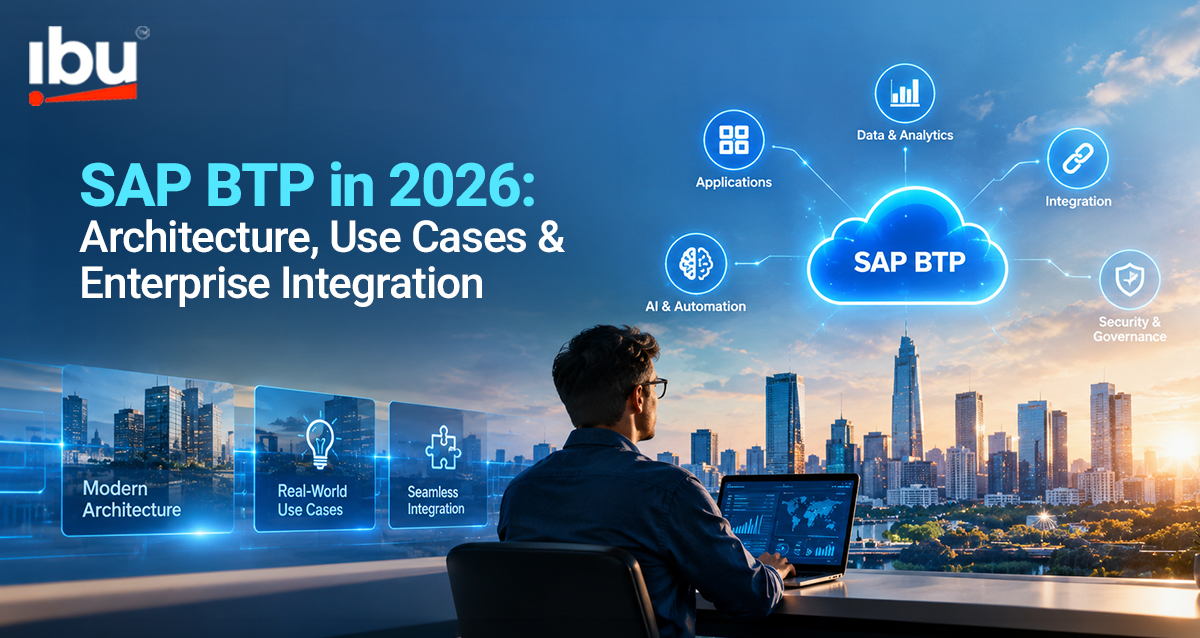
SAP BTP architecture brings together different technology capabilities within a common platform ecosystem.
Its key areas include:
1. Application Development
Build and extend enterprise applications using development tools, services and frameworks.
2. Integration
Connect SAP and third-party applications, APIs, data sources and business processes.
3. Data and Analytics
Support data management, connectivity and analytical capabilities across enterprise environments.
4. Automation
Design and automate workflows to reduce repetitive manual activities.
5. Artificial Intelligence
Access AI services and development capabilities to incorporate intelligence into enterprise applications and processes.
These capabilities allow organizations to develop connected solutions rather than treating every application or technology requirement as a separate project.
How SAP BTP Enables Enterprise Integration
Many organizations operate across multiple technology environments. Finance may run on SAP, sales on a CRM platform, HR on a separate application and reporting on another data system.
Disconnected applications can create duplicate data, manual handovers and limited visibility across business functions.
SAP Integration Suite provides capabilities for connecting applications, APIs, events and processes across SAP and third-party environments.
Integration Platform as a Service
For example, when a customer order is created in a CRM system, an integrated workflow could update the ERP system, trigger inventory checks and notify the relevant teams.
Effective enterprise integration is therefore not just about connecting software. It is about enabling information to move securely and consistently across business processes.
5 Practical SAP BTP Use Cases for Enterprises
Understanding SAP BTP use cases helps organizations identify where the platform can deliver practical business value.
1. Connecting SAP and Non-SAP Applications
Integrate SAP S/4HANA with CRM, HR, procurement and other business applications to reduce disconnected processes and improve information exchange.
2. Developing Custom Business Applications
Use SAP Build and related development capabilities to create applications that address specific operational requirements without unnecessarily modifying the core ERP system.
3. Automating Approval Workflows
Automate purchase approvals, employee requests, document processing and other repetitive workflows using business rules and process automation.
4. Improving Data Connectivity
Connect relevant enterprise data sources to support reporting, analytics and applications that require information from multiple business functions.
5. Building AI-Enabled Business Processes
Develop applications and workflows that incorporate AI capabilities, such as document processing, intelligent assistance and task automation.
These scenarios illustrate how SAP BTP application development and integration capabilities can support modernization across enterprise operations.
SAP BTP and the Clean-Core Approach
One important consideration in SAP modernization is maintaining a clean ERP core.
Historically, extensive customizations within core ERP systems could increase maintenance complexity and make future upgrades more challenging.
A clean-core approach encourages organizations to minimize unnecessary modifications and use supported extension and integration patterns.
SAP BTP supports this approach through side-by-side extensions, allowing businesses to build additional functionality outside the core application while maintaining appropriate connectivity.
For enterprises planning SAP S/4HANA transformation, this can support a more maintainable and adaptable technology architecture.
How Does SAP BTP Support Enterprise AI?
AI becomes more useful when it can operate within actual business processes rather than remaining isolated in standalone tools.
SAP’s AI capabilities support developers and enterprises in building AI-enabled applications and agents connected to relevant business data and workflows.
Capabilities such as Joule Studio, SAP AI Core and the generative AI hub support different aspects of enterprise AI development and management.
For example, an AI-enabled procurement workflow could help process incoming documents, identify relevant information and initiate subsequent tasks, subject to defined business rules and human oversight.
The objective is not simply adding AI to existing applications. It is identifying where intelligence can improve specific business activities while maintaining appropriate security and governance.
When Should Enterprises Consider SAP BTP?
Organizations should evaluate SAP BTP when they need to:
- Integrate multiple SAP and non-SAP applications.
- Modernize existing business processes.
- Build custom applications around SAP environments.
- Support a clean-core transformation strategy.
- Introduce automation across departments.
- Develop AI-enabled enterprise workflows.
Before implementation, businesses should assess existing architecture, integration requirements, security, available technical skills and expected business outcomes.
How IBU Supports Enterprise Technology Integration
At IBU, we help organizations approach technology modernization with a focus on business requirements, existing systems and long-term scalability.
Our technology consulting, application engineering, digital transformation and enterprise integration capabilities can support businesses evaluating SAP BTP adoption and related modernization opportunities.
Whether enterprises are integrating SAP and non-SAP applications, developing BTP extensions or introducing automation, successful delivery depends on having the right technical expertise in place. IBU supports these initiatives by providing specialized SAP, integration, cloud, data and application engineering talent aligned to specific project requirements, technology environments and delivery timelines.
The goal is to create a connected environment that supports operational efficiency today while remaining adaptable to future business requirements.
Frequently Asked Questions
What is SAP BTP used for?
SAP BTP is used to integrate applications and data, develop business applications, extend SAP solutions, automate workflows and incorporate AI capabilities.
Is SAP BTP the same as SAP S/4HANA?
No. SAP S/4HANA is an enterprise resource planning system, while SAP BTP is a technology platform used to build, integrate and extend enterprise applications.
Can SAP BTP integrate non-SAP applications?
Yes. SAP Integration Suite supports integration across SAP and third-party systems, including cloud and hybrid environments.
Does SAP BTP support AI?
Yes. Its AI-related capabilities support developing, integrating and managing AI-enabled applications and agents within enterprise environments.