




6 Agentic AI Use Cases for Business in 2026
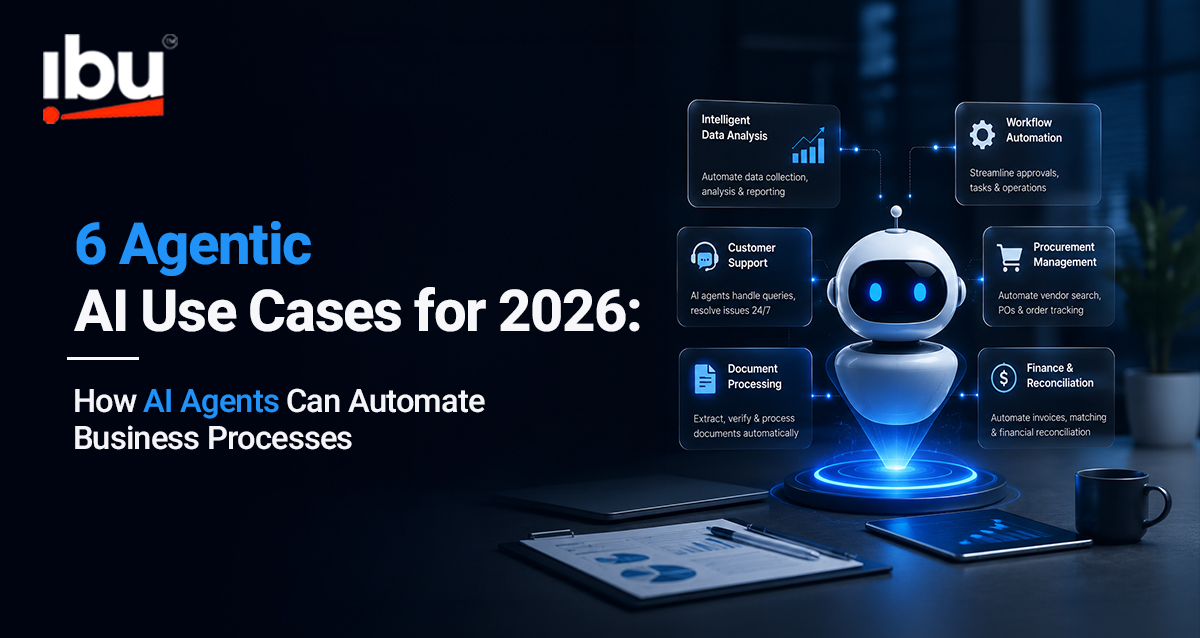
6 Agentic AI Use Cases for 2026: How AI Agents Can Automate Business Processes
Artificial intelligence is moving beyond answering questions and generating content. In 2026, businesses are increasingly exploring AI systems that can plan tasks, interact with enterprise tools and execute multi-step workflows.
This shift is driving interest in agentic AI use cases across customer service, finance, IT, sales, supply chain and HR.
Unlike conventional AI tools that wait for individual prompts, AI agents can work toward defined goals, decide what step comes next and take permitted actions across connected systems.
For organizations exploring agentic AI use cases for business, the opportunity is not simply to automate more tasks. It is to redesign how work moves across people, data and technology.
What Is Agentic AI?
Agentic AI refers to AI systems designed to pursue a defined goal by planning tasks, using tools, making decisions and taking actions within established boundaries.
A typical AI agent can:
- Understand an objective
- Break it into individual tasks
- Access authorized information and systems
- Determine the next appropriate action
- Execute permitted actions
- Evaluate the result
- Continue or escalate to a human
A simplified workflow looks like:
Goal → Plan → Act → Evaluate → Continue or Escalate
This ability makes AI agents for business particularly useful for processes involving multiple applications, repetitive decisions and manual hand-offs.
How Is Agentic AI Different From Generative AI?
Generative AI primarily produces an output such as text, code, images, summaries or analysis. Agentic AI can use those capabilities as part of a broader process to achieve an objective.
For example, generative AI could draft a response to a customer.
An AI agent could potentially understand the customer’s request, retrieve account information, check company policies, initiate an approved action, update the CRM and escalate an exception.
Put simply:
Generative AI creates. Agentic AI can create, decide and act within defined controls.
These agentic AI examples demonstrate why businesses are increasingly looking beyond standalone AI assistants toward workflow-level automation.
6 Agentic AI Use Cases for Business in 2026
Here are six practical agentic AI use cases organizations can explore as part of their automation strategy.
-
Customer Service Automation
Customer service teams often move between CRM platforms, knowledge bases, order-management systems and communication tools to resolve a single request.
An AI agent could classify a request, retrieve customer history, search approved knowledge sources, check an order, perform a permitted action and update the CRM automatically.
Complex or sensitive requests can then be escalated to employees.
Business benefit: Faster resolution of routine requests while customer-service teams focus on interactions requiring judgement and empathy.
-
Finance and Invoice Processing
Finance is one of the strongest potential areas for business process automation with AI because many workflows combine repetitive activities with defined approval rules.
For example:
Invoice received → Data extracted → PO checked → Exception identified → Approval requested → System updated
Rather than employees manually coordinating each stage, an AI agent could manage permitted steps while routing unusual or high-value transactions for human approval.
Among practical agentic AI use cases for business, finance workflows can provide clearly measurable outcomes such as processing time and manual effort.
-
IT Service Management
IT teams regularly handle repetitive requests involving passwords, system access, software, troubleshooting and service tickets.
AI agents could categorize tickets, collect diagnostic information, search technical documentation, execute authorized troubleshooting actions and update the service-management platform.
The important difference is action. Instead of only suggesting how to resolve an issue, an authorized agent can potentially execute predefined steps.
Business benefit: Faster handling of routine IT requests and less repetitive work for technical teams.
-
Sales and Marketing Operations
Sales teams spend valuable time researching prospects, preparing meetings, maintaining CRM data and managing follow-ups.
AI agents for business could research accounts, enrich prospect records, prepare meeting briefs, update CRM information, identify follow-up actions and draft personalized communications.
Marketing teams could similarly use agents to coordinate suitable campaign workflows, analyze information and manage repetitive operational tasks.
These are useful agentic AI examples because the technology supports employees rather than simply replacing individual activities.
-
Supply Chain and Procurement
Supply chains require continuous coordination across inventory, suppliers, procurement, demand and logistics.
An AI agent could detect low inventory, review demand information, check approved suppliers, compare predefined purchasing criteria and prepare an action for approval.
Agents could also monitor delivery exceptions or supplier changes and initiate predefined workflows when required.
For organizations evaluating agentic AI use cases, supply-chain processes demonstrate how agents can connect monitoring, analysis and action within one workflow.
-
HR and Employee Operations
Employee onboarding often requires coordination between HR, IT, managers and several enterprise systems.
An AI agent could collect required information, initiate account requests, coordinate documentation, trigger equipment requests, schedule onboarding activities and track incomplete tasks.
These agentic AI use cases for business could help organizations provide more consistent employee experiences while reducing repetitive administration.
What Are the Benefits of Agentic AI?
The potential benefits of agentic AI extend beyond automating individual tasks.
First, agents can support end-to-end workflow automation, coordinating multiple actions instead of addressing only one isolated task.
Second, they can reduce repetitive manual work such as retrieving information, updating systems and coordinating follow-ups.
Third, agents can help processes move faster by reducing delays between individual workflow stages.
Another of the potential benefits of agentic AI is scalability. Suitable processes can handle increasing volumes without administrative workload necessarily increasing at the same rate.
This makes business process automation with AI particularly valuable when organizations combine automation with well-designed processes and strong enterprise data.
What Are the Risks of Using AI Agents?
Greater autonomy also requires stronger governance.
Before deploying AI agents for business, organizations should determine:
- What data can the agent access?
- Which systems can it use?
- What actions can it perform?
- Which decisions require human approval?
- When should the agent escalate?
- How will its actions be monitored and audited?
Security is particularly important because agents may have permission to interact directly with enterprise systems.
The goal should therefore not be maximum autonomy.
It should be the right level of autonomy with the right level of control.
How Can Businesses Get Started With Agentic AI?
Organizations exploring agentic AI use cases should start with the business problem rather than the technology.
A practical approach is:
- Identifya repetitive, slow or difficult-to-scale workflow.
2. Map its tasks, decisions, systems and approval points.
3. Assess whether the required data is accessible and reliable.
4. Define permissions, restrictions and human oversight.
5. Pilot one controlled use case with measurable outcomes.
6. Measure business value such as time saved, processing speed or service improvement.
7. Scale successful workflows with governance and continuous monitoring.
Not every process needs an AI agent. Businesses should prioritize workflows where automation can create a measurable operational outcome.
The Future of Agentic AI and Business Automation
The next stage of enterprise AI is not simply about generating more content. It is about determining which parts of business workflows can be safely and effectively delegated to intelligent systems.
The most valuable agentic AI use cases will combine AI with connected systems, reliable data, clear governance and human oversight.
At IBU Group, we help organizations evaluate AI opportunities, modernize business processes and build the technology foundations needed to move from AI experimentation to scalable implementation.
The goal isn’t to automate everything. It’s to automate the right work and create measurable business value.
Explore our latest AI insights and business automation updates through our professional network, or speak with our team about your AI requirements.
FAQs
What are agentic AI use cases?
Agentic AI use cases are workflows where AI agents can plan and execute multiple actions toward a defined business goal. Common applications include customer service, finance, IT operations, sales, supply chain and HR.
What are some agentic AI examples?
Common agentic AI examples include an AI agent resolving routine customer requests, processing invoices, managing IT tickets, updating CRM records or coordinating employee onboarding.
Can agentic AI automate business processes?
Yes. Agentic AI can support multi-step business processes involving information retrieval, decisions and system actions. Human oversight should remain in place where decisions involve financial, regulatory, security or other significant risks.
What are the benefits of agentic AI?
The benefits of agentic AI can include faster workflows, reduced repetitive work, greater scalability, improved process coordination and more efficient use of employee time.