




Salesforce Integration: Benefits & Business Efficiency
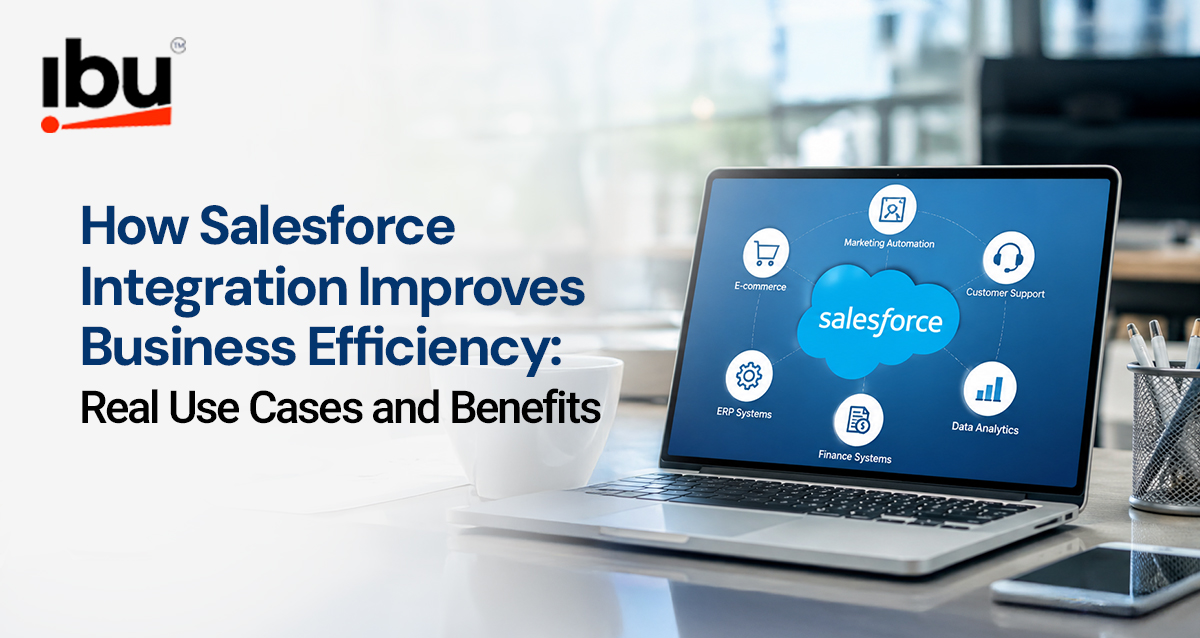
How Salesforce Integration Improves Business Efficiency: Real Use Cases and Benefits
Businesses today operate across multiple systems—from CRM and ERP platforms to marketing automation, finance applications, and customer service tools. While these systems are essential, they often operate in silos, creating disconnected workflows, duplicated data, and inefficient decision-making.
This is where Salesforce Integration becomes a game-changer.
By connecting Salesforce with enterprise applications, organizations can create a unified ecosystem where data flows seamlessly across teams and systems. The result is improved operational efficiency, better customer experiences, and faster business growth.
What is Salesforce Integration?
It is the process of connecting Salesforce CRM with other business applications, databases, and platforms to enable real-time data sharing and workflow automation.
These integrations can include:
- ERP systems
- Marketing platforms
- Billing applications
- Customer service tools
- E-commerce platforms
- Third-party business applications
Instead of manually transferring information between systems, integrated environments ensure that data is synchronized automatically, reducing errors and improving productivity.
Why Businesses Invest in Salesforce Integration
Many organizations invest heavily in digital tools but struggle to realize their full value due to disconnected systems.
Common challenges include:
- Duplicate customer records
- Manual data entry
- Delayed reporting
- Inconsistent customer information
- Limited visibility across departments
Salesforce Integration eliminates these issues by creating a centralized and connected business environment.
When sales, marketing, customer support, and operations teams work with the same data, businesses can make faster and more informed decisions.
How Salesforce and MuleSoft Work Together
One of the most effective approaches to enterprise integration is combining Salesforce and MuleSoft.
MuleSoft provides an API-led integration framework that enables organizations to connect cloud applications, on-premise systems, and third-party platforms without disrupting existing infrastructure.
This approach allows businesses to:
- Connect legacy and modern applications
- Enable real-time data synchronization
- Improve scalability
- Accelerate digital transformation initiatives
Rather than building multiple custom integrations, organizations can create reusable APIs that simplify future integrations and reduce complexity.
Real-World Salesforce Integration Use Cases
-
Customer 360 Experience
Many companies store customer information across different platforms.
Sales data may exist in Salesforce, support data in a service platform, and billing information in an ERP system.
Through Salesforce Integration, organizations can create a complete Customer 360 view, giving teams access to unified customer information and enabling more personalized interactions.
-
Sales and ERP Integration
A common challenge for businesses is aligning sales processes with financial systems.
Integrating Salesforce with ERP platforms helps automatically synchronize:
- Orders
- Invoices
- Product catalogs
- Inventory information
This reduces manual work and allows teams to process transactions more efficiently.
-
Marketing Automation
Marketing teams depend on accurate customer data to deliver relevant campaigns.
Salesforce Integration enables seamless connections between CRM and marketing platforms, allowing businesses to:
- Segment audiences accurately
- Personalize campaigns
- Track engagement across channels
- Measure marketing ROI effectively
-
Customer Service Optimization
Customer support teams often struggle when customer information is dispersed across multiple systems.
Integrating service platforms with Salesforce enables agents to access complete customer histories quickly, resulting in faster issue resolution and improved customer satisfaction.
Why Salesforce Integration Is Critical for Digital Transformation
Digital transformation is not simply about adopting new technology.
It is about creating connected experiences across customers, employees, and business processes.
Organizations that invest in integration are better positioned to:
- Adapt to market changes
- Improve operational agility
- Accelerate innovation
- Deliver seamless customer experiences
Without integration, even the most advanced platforms can become isolated systems that limit business performance.
Salesforce Integration and the Future of Enterprise Technology
As businesses continue adopting cloud technologies, AI-driven applications, and automation platforms, integration will become even more important.
Modern enterprises require systems that can communicate efficiently, share data securely, and support real-time decision-making.
Salesforce Integration, supported by technologies like MuleSoft and API-led connectivity, provides the foundation for this connected future.
Organizations that build integration-first architectures today will be better prepared to scale, innovate, and compete in rapidly evolving markets.
Frequently Asked Questions
What is Salesforce Integration?
Salesforce Integration is the process of connecting Salesforce CRM with other business applications, databases, and platforms to enable seamless data exchange and workflow automation.
Why is Salesforce Integration important?
It improves data accuracy, increases productivity, reduces manual effort, and provides a unified view of business operations.
What is MuleSoft used for in Salesforce Integration?
MuleSoft helps organizations connect enterprise applications, APIs, cloud platforms, and legacy systems through a scalable integration framework.
What systems can integrate with Salesforce?
Salesforce can integrate with ERP systems, marketing platforms, customer service tools, finance applications, e-commerce solutions, and many third-party business systems.
How does Salesforce Integration improve customer experience?
It creates a complete view of customer information, enabling businesses to provide personalized interactions, faster support, and consistent experiences across channels.
Is Salesforce Integration suitable for large enterprises?
Yes. Enterprises often use Salesforce Integration to connect complex environments consisting of multiple cloud applications, legacy systems, and business-critical platforms.
Conclusion
Salesforce Integration has become a critical enabler of business efficiency and digital transformation. By connecting systems, automating workflows, and creating a unified view of operations, organizations can reduce complexity and unlock greater value from their technology investments.
Whether the goal is improving customer experience, streamlining operations, or modernizing legacy infrastructure, Salesforce Integration provides the foundation for scalable, connected, and future-ready business growth.