





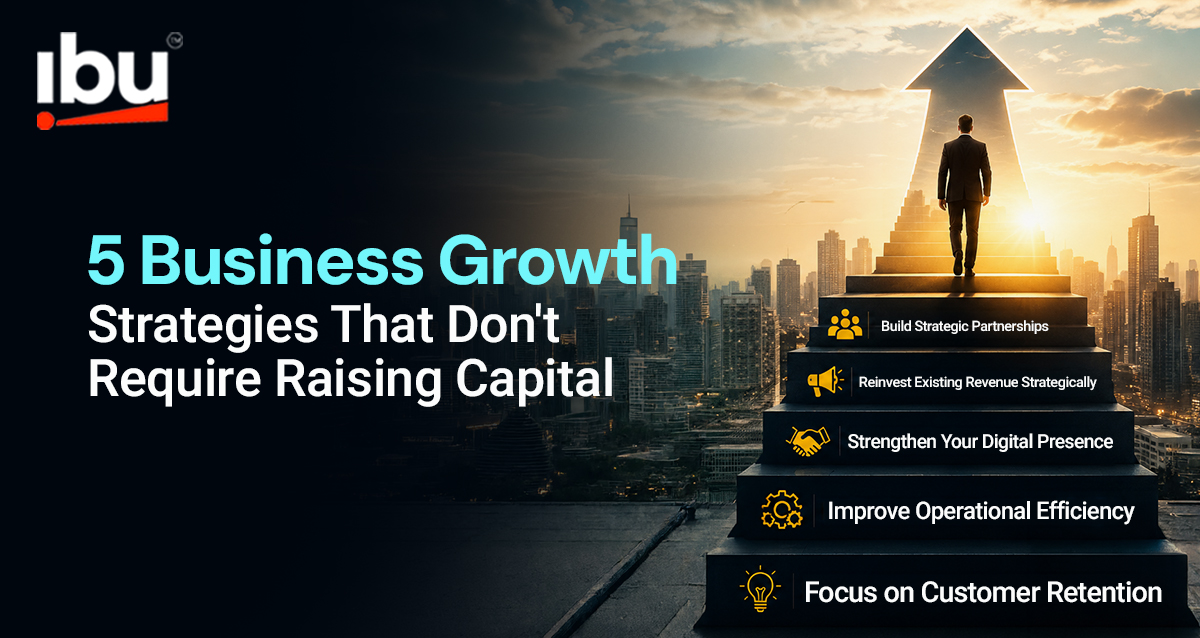
5 Business Growth Strategies Without Raising Capital
5 Business Growth Strategies That Don’t Require Raising Capital
When business leaders think about growth, funding is often the first solution that comes to mind. While access to capital can help accelerate expansion, it is not always the most important factor behind sustainable business growth.
Many successful businesses scale without raising additional capital by improving operations, strengthening customer relationships, leveraging partnerships, and making smarter strategic decisions. In fact, organizations that focus on profitability, efficiency, and resource optimization often build stronger foundations for long-term success than those relying solely on external funding. These business growth strategies allow organizations to improve performance and expand while maintaining greater financial control.
The reality is that growth is not always about having more money. Sometimes, it is about making better use of the resources you already have.
In this article, we’ll explore five practical business growth strategies that can help organizations expand without raising additional capital.
Can a Business Grow Without Raising Capital?
Yes. Many businesses achieve sustainable growth by improving operational efficiency, increasing customer lifetime value, building strategic partnerships, and reinvesting existing revenue into high-impact initiatives.
While funding can create opportunities for expansion, it does not automatically solve business challenges. Organizations that focus on strong fundamentals are often better positioned to scale successfully while maintaining greater control of their operations and long-term vision.
1. Build Strategic Partnerships
One of the fastest ways to expand without significant investment is through strategic partnerships.
Partnerships allow businesses to access new customers, markets, capabilities, and expertise without building everything internally.
Examples include:
- Technology partnerships
- Sales and distribution partnerships
- Industry collaborations
- Referral partnerships
- Joint go-to-market initiatives
A well-structured partnership can help businesses accelerate growth, increase credibility, and create new revenue opportunities while minimizing costs.
Instead of investing heavily in expansion efforts, organizations can leverage the strengths and capabilities of trusted partners to achieve shared goals. As part of effective business growth strategies, strategic partnerships can help companies expand their capabilities without significantly increasing costs.
Why It Works
- Access to new markets
- Faster business expansion
- Shared resources and expertise
- Reduced growth risk
2. Focus on Customer Retention
Many businesses invest significant time and resources into acquiring new customers while overlooking the value of existing ones.
However, retaining customers is often more cost-effective than constantly pursuing new acquisitions.
Loyal customers are more likely to:
- Make repeat purchases
- Purchase additional services
- Refer others to your business
- Increase long-term revenue
Organizations that improve customer experiences, strengthen relationships, and deliver consistent value often experience sustainable growth without increasing marketing spend.
3. Customer Retention Strategies
- Personalized customer engagement
- Loyalty programs
- Proactive customer support
- Regular feedback collection
- Continuous service improvement
Growth is not always about finding more customers.
Sometimes it is about maximizing the value of the customers you already have.
4. Improve Operational Efficiency
As businesses grow, inefficiencies often grow with them.
Manual processes, disconnected systems, duplicate work, and poor visibility can have a significant impact on profitability and scalability.
Operational efficiency is one of the most overlooked business growth strategies.
Organizations that streamline operations can:
- Reduce costs
- Increase productivity
- Improve service delivery
- Scale more effectively
Examples of improvement initiatives include:
- Process automation
- Systems integration
- Workflow optimization
- Data centralization
- Performance monitoring
When businesses eliminate unnecessary complexity, they create more capacity for growth without increasing operational expenses.
Why Efficiency Matters
Every dollar saved through operational improvement can be reinvested into business growth initiatives.
Strengthen Your Digital Presence
Today’s customers discover, evaluate, and engage with businesses online.
A strong digital presence can generate long-term growth without requiring significant capital investments.
Businesses that invest in digital visibility can expand their reach through:
- Search Engine Optimization (SEO)
- Content marketing
- Thought leadership
- Social media engagement
- Customer education
Unlike paid advertising, which often requires continuous spending, a well-executed digital strategy can deliver lasting visibility and organic traffic.
By creating valuable content that answers customer questions and addresses industry challenges, businesses can build authority, attract qualified prospects, and generate new opportunities over time.
Long-Term Benefits
- Increased brand awareness
- More organic traffic
- Higher credibility
- Sustainable lead generation
- Stronger customer trust
5. Reinvest Existing Revenue Strategically
One of the most effective growth strategies is also one of the simplest: reinvesting profits back into the business.
Rather than pursuing external capital immediately, many successful organizations focus on funding growth through existing revenue.
This approach encourages:
- Financial discipline
- Responsible scaling
- Better investment decisions
- Long-term sustainability
Businesses can reinvest profits into:
- Technology upgrades
- Product development
- Employee training
- Customer experience improvements
- Marketing initiatives
Organizations that prioritize strategic reinvestment often develop stronger financial resilience and greater operational control.
Growth Through Reinvestment
The goal is not to spend more.
The goal is to invest where the returns will have the greatest impact.
Why Sustainable Growth Matters More Than Rapid Growth
Rapid growth can be exciting, but it often introduces new challenges.
Without the right systems, processes, and strategy, businesses can struggle to maintain profitability and operational stability.
Sustainable growth focuses on creating a strong foundation through:
- Strategic planning
- Efficient operations
- Customer loyalty
- Strong partnerships
- Continuous improvement
This approach reduces risk while improving long-term business performance.
The businesses that thrive over time are not always the fastest-growing.
They are often the most prepared.
FAQs
What are business growth strategies?
Business growth strategies are actions and initiatives designed to help organizations increase revenue, expand operations, improve profitability, and achieve long-term success.
Can a business grow without raising capital?
Yes. Businesses can grow through strategic partnerships, customer retention, operational improvements, digital marketing, and reinvesting existing revenue.
What is the fastest way to grow a business?
There is no single growth strategy that works for every organization. However, strategic partnerships, customer retention, and operational efficiency often deliver significant results without requiring major investments.
Why are strategic partnerships important for growth?
Strategic partnerships provide access to expertise, markets, customers, and resources that help businesses scale more efficiently while reducing risk.
How does customer retention contribute to business growth?
Retaining customers increases lifetime value, improves profitability, generates referrals, and reduces customer acquisition costs.
What role does operational efficiency play in business growth?
Operational efficiency helps businesses reduce costs, improve productivity, increase profitability, and create scalable processes that support long-term growth.
Ready to Scale Your Business Strategically?
Growth isn’t always about raising more capital.
Often, the greatest opportunities come from improving operations, strengthening partnerships, and creating a scalable growth strategy that aligns with your business objectives.
Connect with our advisory experts:
https://ibugroup.co.uk/
Discover how IBU helps businesses unlock sustainable growth through strategic partnerships, operational improvement, and business transformation initiatives.
Conclusion
While funding can accelerate expansion, it is not the only path to growth. Businesses that focus on strategic partnerships, customer retention, operational efficiency, digital visibility, and reinvestment often build stronger and more sustainable foundations for success.
The most successful growth strategies are not always the most expensive.
They are the ones that create long-term value.
By focusing on the right fundamentals, organizations can scale confidently, improve profitability, and strengthen their competitive position without raising additional capital.